
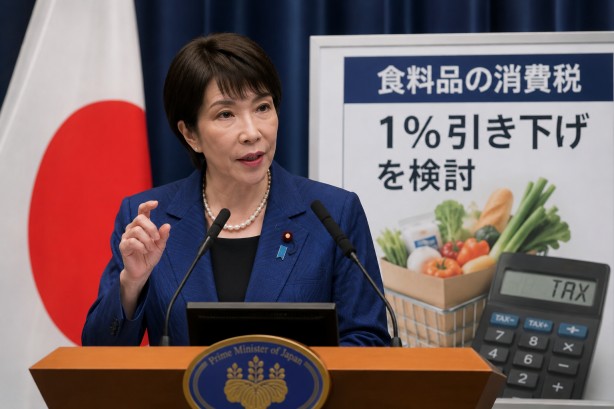
In a move aimed at alleviating the financial strain on households, Japan’s Prime Minister Sanae Takaichi plans to direct the Liberal Democratic Party to advance a proposal that would significantly reduce the consumption tax on food items. The initiative suggests slashing the tax rate from 8% to a mere 1% for a temporary period of two years, commencing in April 2027. This step comes in response to an impasse in discussions across political parties concerning tax reform.
The government, along with the ruling coalition, has expressed support for the proposed tax reduction, viewing it as a timely measure to provide relief to citizens. In addition to the tax cut, there is also a plan to offer financial assistance to low- and middle-income families, amounting to approximately ¥600 billion. This support package is designed to mitigate the rising cost-of-living pressures faced by many Japanese households.
Efforts to finalize this policy are underway, with the government targeting early August for its completion. The intention is to prepare the necessary legislative framework in time for an extraordinary parliamentary session scheduled later this year. This timeline aims to ensure that the measures can be implemented by the following April, providing prompt relief to consumers.
The proposed tax reform has emerged as a focal point in Japan’s broader economic strategy, as the country grapples with balancing fiscal responsibility and social welfare. By targeting essential food items, the government seeks to directly address the everyday expenses that most impact household budgets. This initiative, if successful, could serve as a model for other nations facing similar economic challenges.