
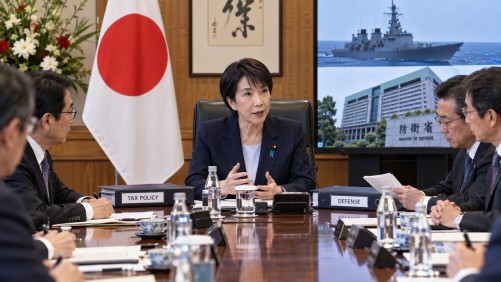
Japan’s government is gearing up to tackle a series of formidable economic, diplomatic, and national security challenges under the leadership of Prime Minister Sanae Takaichi. As the newly reshuffled Cabinet prepares to commence its duties next month, critical legislative efforts are on the agenda, with the primary focus on economic reforms aimed at easing the financial burden on citizens.
The administration plans to introduce key legislation during an extraordinary session of the Diet scheduled for early October. A significant proposal involves reducing the consumption tax on food items and implementing income-linked cash payments to support households. Despite the ambitious agenda, the ruling coalition, comprised of the Liberal Democratic Party and Nippon Ishin, lacks a majority in the Upper House, necessitating collaboration with opposition parties to pass these measures.
In a strategic move, Finance Minister Satsuki Katayama has been retained in her role, tasked with spearheading the proposed economic legislation. Additionally, efforts are underway to address the reform demand of Nippon Ishin by reducing the number of seats in the Lower House, indicating a broader commitment to structural political changes.
On the diplomatic front, Foreign Minister Toshimitsu Motegi and Defense Minister Shinjiro Koizumi remain in their positions, as Japan seeks to navigate complex relations with key global powers, particularly China and the United States. The geopolitical climate is tense, largely due to security concerns related to Taiwan. Prime Minister Takaichi is expected to participate in the upcoming Asia-Pacific Economic Cooperation summit in Shenzhen, China, this November, a move that underscores Japan’s efforts to maintain regional stability.
National security is another pressing priority, with plans to revise Japan’s three principal security documents, including the National Security Strategy, by the year’s end. This revision aims to align Japan’s foreign and defense policies with evolving global dynamics. Concurrently, debates over increased defense spending continue, with the government exploring ways to finance such initiatives without exacerbating public financial pressures. Prime Minister Takaichi has also emphasized the importance of constitutional reform, although tangible progress on drafting amendment proposals has been limited.